
How to Reduce Hotel Booking Abandonment with AI Chat: 7 Guest Conversations


A guest can like your hotel and still leave without booking because one question remains unanswered. Myma AI helps hotels handle those questions through guest communication tools, giving travelers a clearer path from interest to a reservation.
For operators, the goal is more completed direct bookings, supported by accurate answers and reliable staff follow-up. More chat activity alone does not prove that you saved revenue.
What Is Hotel Booking Abandonment?
Hotel booking abandonment occurs when a guest starts booking a room on a hotel’s website or booking engine but leaves before completing the reservation. Unclear pricing, unanswered questions, complicated checkout steps, or payment issues can cause guests to abandon the process, resulting in lost potential direct bookings.
Booking abandonment: A traveler starts your reservation process but leaves before completing it.
Booking engine abandonment: Drop-off within your booking engine after a defined starting event, such as beginning checkout.
OTA leakage: A traveler researches your property on your website but completes the reservation through an online travel agency.
Micro-conversion: A smaller action, such as choosing a room or opening a booking link, that can move a traveler toward booking.
Conversion rate optimization (CRO): Improving the experience so more visitors complete a desired action, including a confirmed reservation.
AI chat can reduce uncertainty, explain choices and connect guests with staff. A well-configured hotel chatbot supports your direct booking channel while leaving availability, payments and confirmations to the appropriate systems.
Start with Your Own Numbers
Avoid treating a widely quoted abandonment rate as your hotel's baseline. Website exits, booking-engine exits and abandoned checkouts measure different stages.
Figure or measure | What it tells you | What it does not prove |
70.22% average documented shopping-cart abandonment in Baymard's research | Abandonment is common across ecommerce | Your hotel's abandonment rate; this is not a hotel-specific benchmark |
Your checkout starts versus completed reservations | Where your defined booking funnel loses guests | Whether every guest who leaves is permanently lost |
Chat-assisted confirmed bookings | Reservations associated with a chat interaction | That chat caused every associated booking |
The first figure comes from Baymard's cart abandonment research, which combines 50 studies. Use it as context, then measure your property independently.
Chat belongs within a wider direct booking strategy. Slow pages, broken payments and confusing mobile forms still need fixing.
7 Guest Conversations That Can Prevent Booking Drop-Off
These transcripts are illustrative examples, not customer results or live Myma conversations. Rates, policies and amenities are fictional; live data, booking links and staff handoffs require the relevant setup and integrations.
1. “What Will This Stay Actually Cost?”
Unexpected charges can make a traveler pause. Give guests a clear explanation before they reach payment.
Guest: I see $220 per night. Is there a resort fee? Hotel AI Bot: The displayed $220 includes our mandatory resort fee. Taxes are shown separately in the booking summary, and optional valet parking is $35 per night. Guest: We won't need valet. Where do I see the full amount? Hotel AI Bot: Open the booking summary for your dates. It shows the final amount before payment, including taxes and any extras you choose.
Booking barrier removed: unclear total cost. The bot should use current, approved information and avoid calculating a live quote without a dependable data source.
US operators should review the FTC's guidance on unfair or deceptive fees. Its lodging requirements include displaying mandatory fees in the total advertised price, with specified treatment for taxes and other charges.
Align chat wording with your booking engine and connected hotel systems. An explanation cannot repair a misleading rate display.
2. “Which Room Works for Our Family?”
Room names can confuse travelers who simply need enough space and beds. Help them compare the features that matter.
Guest: We're two adults and two kids, ages 8 and 11. Is a king room big enough? Hotel AI Bot: Our standard king room allows two guests. The two-queen room allows four and has two queen beds. Guest: Does the two-queen room have a refrigerator? Hotel AI Bot: Yes, it has a mini refrigerator. Would you like to check that room type for your dates?
Booking barrier removed: uncertainty about room suitability. Match occupancy limits, bed types and amenities to the guest's needs before offering a booking link.
Your room classification guide can support clearer descriptions. Keep those descriptions consistent with the information used in conversational AI for hospitality.
3. “Can I Cancel If My Plans Change?”
Travelers often compare flexible and non-refundable rates. A vague answer can send them back to an OTA to search for clearer terms.
Guest: My meeting might move. Can I cancel this room? Hotel AI Bot: That depends on the rate you choose. Our Flexible Rate allows cancellation until 6 p.m. hotel local time, two days before arrival; the Advance Purchase Rate is non-refundable. Guest: I should choose Flexible, then? Hotel AI Bot: If your dates may change, review the Flexible Rate's full terms before booking. I can direct you to that option in the booking engine.
Booking barrier removed: unclear commitment. State the rate-specific deadline and hotel time zone rather than giving a blanket promise.
Use consistent wording in your booking confirmation messages. Configure the assistant's answers and boundaries using a structured hotel chatbot implementation process.
4. “Will Your Accessible Room Meet My Needs?”
“Accessible” does not describe every feature a traveler needs. Give specific information and route questions that require confirmation to a trained employee.
Guest: I use a wheelchair. Does the accessible room have a roll-in shower? Hotel AI Bot: Our Accessible King with Roll-In Shower has that feature and a step-free route from the lobby. Our other accessible king category has a bathtub. Guest: Can you confirm the room for October 23–25? Hotel AI Bot: I'll connect you with reservations to check that exact room category for those dates. This conversation has not reserved a room yet.
Booking barrier removed: missing accessibility details. The ADA's lodging reservation provisions address identifying and describing accessible features so travelers can assess suitability.
Apply the same care to AI concierge support. Helpful concierge workflows give guests a clear next step when staff judgment is needed.
5. “We're Arriving After Midnight”
Late arrivals create practical concerns about reception, transportation and entering the building. Address those concerns before asking for the booking.
Guest: Our flight lands at 11:30 p.m. Can we check in around 1 a.m.? Hotel AI Bot: Our front desk is staffed overnight. Book from the evening before your 1 a.m. arrival, and tell reservations your expected arrival time. Guest: What if the flight is delayed? Hotel AI Bot: Contact the hotel if your arrival changes. I can share our overnight contact details and directions to the entrance.
Booking barrier removed: arrival uncertainty. Make the correct booking date explicit and explain the property's actual late-arrival procedure.
Keep directions and arrival information in your digital hotel compendium. Approved follow-up messages through a hotel guest messaging platform can help guests find that information later.
6. “I'm Comparing You with an OTA”
A traveler may switch channels because an OTA presents the offer more clearly. Explain genuine direct-booking benefits without inventing discounts or guarantees.
Guest: I found you on a booking site. Why book here? Hotel AI Bot: Our direct Flexible Rate includes breakfast for two. Compare the same room, dates, cancellation terms and total price before choosing. Guest: The booking site has a lower non-refundable rate. Hotel AI Bot: That has different cancellation terms. I can show our direct non-refundable option too, so you can compare equivalent offers.
Booking barrier removed: an unclear value comparison. This supports reduced OTA leakage without pressuring the guest or making unsupported “lowest price” claims.
Keep benefits consistent across your omnichannel guest experience. If the traveler continues on another channel, use an agreed omnichannel communication strategy.
7. “The Booking Page Isn't Working”
A payment error can end an otherwise successful journey. The bot should offer a useful recovery path while protecting sensitive information.
Guest: I entered everything, but the page froze. Am I booked? Hotel AI Bot: A frozen page doesn't confirm a booking. Please check for a confirmation number before trying again; don't send card details in this chat. Guest: I don't see a confirmation email. Hotel AI Bot: I can connect you with reservations to check whether a booking exists. Would you prefer live help, if available, or an email follow-up?
Booking barrier removed: uncertainty after a technical failure. Avoid repeated payment attempts until the hotel's authorized team or system checks the booking status.
An AI email assistant can support follow-up drafting. Teams evaluating guest communication platforms should test this handoff rather than assuming it works.
How Small Booking Steps Affect Revenue
A room-selection click or resolved question can help a guest continue. It becomes financially meaningful only when additional bookings complete or reservations move from a commission-bearing channel to direct.
Illustrative revenue calculation: additional bookings Assume 1,000 checkout starts, 200 completed bookings and $600 average room revenue per reservation. Completion improves from 20% to 22%: 20 additional bookings × $600 = $12,000 additional gross room revenue. This is a hypothetical 2-percentage-point improvement, not a Myma forecast or profit figure. Subtract cancellations, delivery costs and channel costs when assessing the actual contribution.
Illustrative savings calculation: channel shift Assume 10 existing reservations move from an OTA to direct, each worth $600, with an assumed 18% OTA commission.10 × $600 × 18% = $1,080 in avoided OTA commission, before direct-channel acquisition and transaction costs. These are channel-shift savings, not additional room revenue. Do not count the same booking twice.
When evaluating AI agents for hotels, ask which completed outcomes the system can demonstrate. A resolved question is valuable, but it is not a confirmed sale.
Measure Results Without Overclaiming
Use Google's ecommerce measurement guide to plan checkout and purchase events with your booking-engine provider. Verify that each confirmed reservation is recorded once.
Metric | Simple calculation | Why it matters |
Checkout abandonment | (Checkout starts − completed bookings) ÷ checkout starts | Tracks drop-off within a consistent funnel |
Chat-assisted booking rate | Confirmed bookings associated with chat ÷ eligible chat sessions | Shows association, not proven incremental lift |
Net booking contribution | Retained room revenue − relevant delivery and acquisition costs | Connects performance to financial value |
If your website and booking engine use different domains, follow Google's cross-domain measurement guidance. Compare device types, traffic sources and similar demand periods; use a controlled test where possible.
A Simple 30-Day Implementation Plan
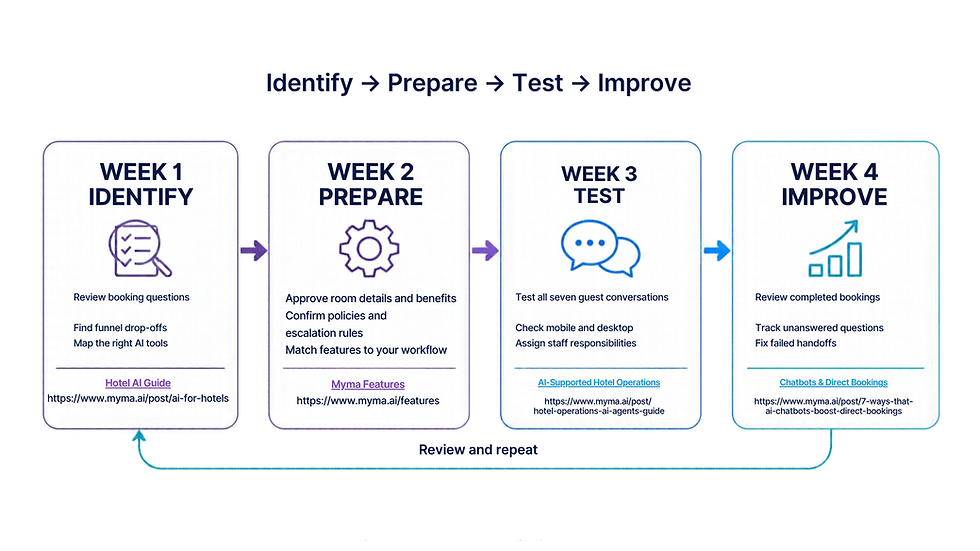
Week 1 — Identify: Review booking questions and funnel drop-offs. Use the broader Myma hotel AI guide to map the right tools to each problem.
Week 2 — Prepare: Approve room details, benefits, policies and escalation rules. Check the relevant Myma features against your actual workflow.
Week 3 — Test: Run all seven conversations on mobile and desktop. Give staff clear responsibilities, following the principles in AI-supported hotel operations.
Week 4 — Improve: Review completed bookings, unanswered questions and failed handoffs. Apply proven communication principles from chatbot-supported direct bookings to the problems you observe.
Common Questions from Hotel Operators
Can AI chat fix every abandoned booking?
No. Guests may change plans, find another property or encounter a payment issue that needs technical support. Chat is most useful when missing information or delayed help prevents the guest from continuing.
Should the chatbot offer a discount?
Only when your hotel has approved that offer and its conditions. Start by explaining room suitability, cancellation terms and genuine direct-booking benefits before assuming a lower rate is necessary.
What should happen when the bot cannot answer?
It should acknowledge the gap and offer a clear route to staff. Pass along the question and details already collected, then tell the guest whether help is immediate or requires follow-up.
Turn Booking Questions into Clear Next Steps
Reducing hotel booking abandonment starts with understanding why guests hesitate. AI chat helps when it answers accurately, makes the next step easy and brings a person into the conversation at the right moment.
Start with these seven conversations, measure confirmed outcomes and fix the gaps guests reveal. To assess how those workflows would work at your property, contact Myma AI with your booking engine, common guest questions and current handoff process.


Comments