
Luxury Hotel Email Marketing Platforms: A Guide for USA Luxury Properties 2027

Updated: 7 days ago

Luxury hotel email marketing is about more than sending promotional newsletters. It is about creating personalized guest experiences, strengthening customer relationships, promoting premium services, and encouraging repeat direct bookings through relevant email communication.
For hotels, the right email marketing platform can help manage guest databases, segment customers by preferences and booking history, automate pre-arrival and post-stay campaigns, and measure the revenue generated by marketing activities.
Luxury properties have additional requirements, including VIP guest recognition, personalized offers, brand-consistent communication, and integration with hotel property management systems (PMS).
However, not every email marketing platform is designed for hospitality. Some solutions specialize in hotel CRM and guest lifecycle marketing, while others offer general-purpose email campaigns, customer relationship management, and marketing automation.
This guide compares eight email marketing platforms for hotels, explains which tools are suitable for luxury properties, and explores the strategies hotels can use to build more personalized email campaigns and stronger guest relationships.
Quick Answer: What Are the Luxury Hotel Email Marketing Platforms?
The best email marketing platform depends on your hotel's size, guest database, technology infrastructure, and marketing objectives.
Revinate Marketing, Cendyn CRM, dailypoint, and Profitroom are worth considering for hotels looking for hospitality-focused guest marketing and CRM capabilities. Mailchimp and Brevo are alternatives for general email campaigns, while HubSpot and ActiveCampaign offer broader CRM and marketing automation capabilities.
For luxury hotels, the most important capabilities are guest segmentation, personalized campaigns, PMS and booking-engine connectivity, automated guest journeys, and campaign revenue reporting.
Luxury Hotel Email Marketing Platforms Compared
Before selecting a platform, compare its hospitality capabilities, marketing features, integration options, and suitability for your property.
Platform | Best for | Main strengths | Property fit |
Revinate Marketing | Hotel email marketing | Guest segmentation and lifecycle campaigns | Independent hotels and groups |
Cendyn CRM | Enterprise hotel CRM | Unified guest profiles and multichannel marketing | Luxury hotels and hotel groups |
dailypoint | Guest data and personalization | Centralized profiles and targeted marketing | Premium hotels and groups |
Profitroom | Hotel marketing automation | Guest database, triggered campaigns and direct bookings | Independent hotels and resorts |
Mailchimp | Email newsletters | Campaign creation and audience management | Small hotels and boutique properties |
HubSpot | CRM and marketing workflows | Lead management and automation | Hotel groups and sales teams |
Brevo | Email and multichannel campaigns | Email, SMS and marketing automation | Smaller and growing properties |
ActiveCampaign | Advanced marketing automation | Behavioral segmentation and conditional workflows | Hotels with complex marketing journeys |
These platforms serve different needs. This is a feature-based shortlist, not a ranking based on independent product testing. Confirm current pricing, integrations, and feature availability directly with each provider before purchasing.
1. Revinate Marketing – Best for Hotel-Specific Email Marketing

Revinate is a hospitality-focused marketing platform designed to help hotels communicate with guests throughout their booking and stay journey.
Unlike general email marketing applications, Revinate Marketing is built around hotel guest relationships. Hotels can use guest information and campaign segmentation to send more relevant emails to prospective, current, and returning guests.
Key Features
Hotel-focused email campaign management.
Guest segmentation and personalized communications.
Drag-and-drop email creation.
Email campaign analytics.
Pre-arrival and post-stay marketing.
Campaigns supporting direct-booking and guest-retention strategies.
How Hotels Can Use Revinate
A resort could use Revinate to communicate with previous guests who booked premium suites during the holiday season. Instead of sending the same seasonal newsletter to its entire database, the hotel could create a targeted campaign featuring premium accommodation, dining experiences, and exclusive seasonal packages.
Hotels can also use guest lifecycle campaigns to reconnect with previous visitors and encourage future direct reservations.
Best suited for: Independent hotels, resort operators, and hospitality groups looking for dedicated hotel email marketing capabilities.
Consider before purchasing: Evaluate its available PMS and booking-engine integrations, guest data synchronization, campaign reporting, and multi-property capabilities.
2. Cendyn CRM – Best for Luxury Hotel Groups and Enterprise Marketing
Cendyn offers hospitality technology focused on hotel CRM, guest data management, marketing automation, and revenue growth.
Its CRM platform brings together guest information from different hospitality systems to create more complete customer profiles. This can help hotel marketing teams understand guest preferences and deliver more relevant campaigns.
Key Features
Centralized guest profiles.
Guest segmentation across customer groups.
Email and SMS marketing capabilities.
Multi-property campaign management.
Marketing automation.
Campaign analytics and performance reporting.
Campaign creation and approval workflows.
How Luxury Hotels Can Use Cendyn
Consider a luxury hotel group operating properties in multiple destinations.
A returning guest who previously booked a premium suite at one property may be interested in a similar experience at another destination. A centralized CRM can help the marketing team understand the relationship and deliver relevant destination-specific communication.
Hotel groups can also use centralized campaign governance to maintain brand consistency while allowing individual properties to communicate offers relevant to their guests.
Best suited for: Luxury hotel groups, larger hotel operators, and businesses requiring centralized guest data and coordinated marketing.
Consider before purchasing: Ask about property-level permissions, guest-profile matching, PMS connectivity, data governance, and the cost of implementing integrations.
3. dailypoint – Best for Guest Data Management and Personalized Hotel Marketing

dailypoint is a hospitality-focused customer data platform that helps hotels collect, consolidate, and activate guest information from multiple systems.
Its approach centers on building unified guest profiles that support CRM, loyalty, marketing, and guest communication activities.
For luxury hotel email marketing, this type of customer data management can be especially useful. Personalization requires more than inserting a guest's first name into an email. Hotels need reliable information about guest preferences, interests, previous stays, and interactions.
Key Features
Centralized guest profiles.
Guest data consolidation across hospitality systems.
CRM and loyalty capabilities.
Campaign management.
Email, SMS, and WhatsApp communication capabilities.
Automated marketing workflows.
Guest-interest-based segmentation and personalization.
How Hotels Can Use dailypoint
A luxury resort could create different guest segments based on interests such as wellness, fine dining, family holidays, and premium accommodation.
Its marketing team can then develop campaigns that match those interests rather than sending identical promotional emails to everyone.
For example, a returning guest who previously showed interest in spa treatments could receive a wellness-focused seasonal offer.
Best suited for: Luxury properties, hospitality groups, and hotels that want to unify guest information before building more advanced personalized marketing campaigns.
Consider before purchasing: Review data integration requirements, guest identity matching, campaign capabilities, and how effectively its customer profiles connect with your current hotel technology.
4. Profitroom – Best for Hotel Marketing Automation and Direct Bookings
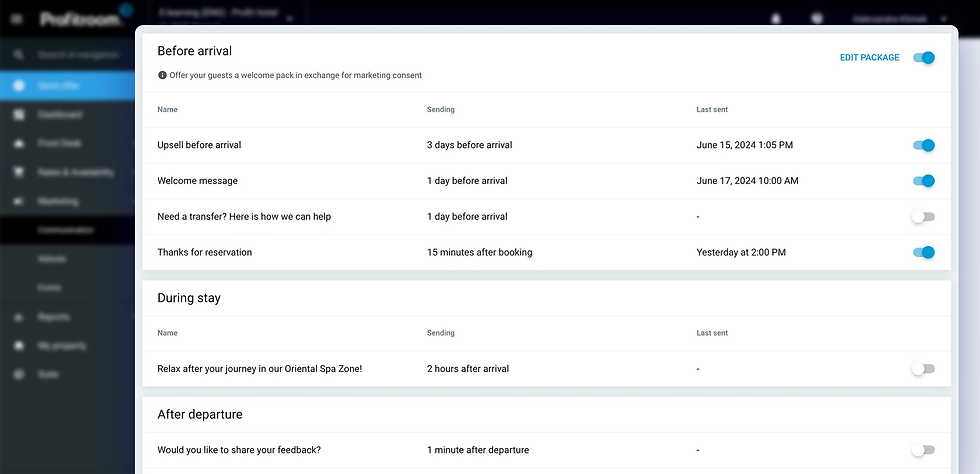
Profitroom provides hotel-focused CRM and marketing automation capabilities designed to help properties build guest relationships and encourage direct bookings.
Its marketing tools support automated email campaigns, personalized communications, triggered messages, and recurring seasonal campaigns.
Profitroom also connects its marketing capabilities with its broader hotel booking and guest database solutions.
Key Features
Automated email campaigns.
Triggered guest communication.
Personalized email content.
Guest database management.
Automated audience segmentation.
Seasonal and recurring campaigns.
Pre-arrival upselling.
Discount codes and promotional offers.
How Hotels Can Use Profitroom
An independent hotel could create a pre-arrival email campaign for guests with upcoming reservations.
The campaign might introduce the hotel's facilities, explain available services, and present optional extras such as breakfast packages, room upgrades, or wellness experiences.
After departure, the hotel could use a separate campaign to maintain the relationship and promote future direct bookings.
Best suited for: Independent hotels, resorts, and hospitality businesses looking for integrated hotel marketing and booking-related capabilities.
Consider before purchasing: Check whether your booking engine and PMS are supported, what data is synchronized, and which automation capabilities are included in your selected package.
5. Mailchimp Hospitality Edition

Best For: User-Friendly Newsletter & Seasonal Campaigns
Mailchimp dominates the affordable automation space. Its hospitality-specific templates include pre-built campaigns for seasonal promotions, local event notifications, and last-minute availability alerts. Perfect for vacation rental managers juggling multiple properties.
The platform's strength is simplicity. Create a "Summer Special" campaign in 10 minutes, segment by past booking dates, and schedule send times based on guest time zones. Mailchimp's mobile app lets you approve campaigns poolside.
Key Benefits:
Drag-and-drop email builder with 100+ hospitality templates
A/B testing on subject lines and send times
Predictive analytics showing optimal campaign timing
Social media ad integration for multi-channel campaigns
Free plan for up to 500 contacts
Mailchimp lacks the deep PMS integration of specialized tools, requiring some manual list management. But for straightforward campaigns focused on past guests, it delivers consistent results at a fraction of enterprise costs.
How Hotels Can Use Mailchimp
A boutique hotel could use Mailchimp to send a monthly newsletter featuring destination recommendations, seasonal accommodation offers, local events, and updates about hotel facilities.
The hotel could also organize contacts into audience segments based on information collected with appropriate permissions.
For instance, previous leisure travellers could receive a seasonal holiday campaign, while corporate contacts receive business accommodation updates.
Best suited for: Boutique hotels, smaller properties, and hotel marketing teams that primarily need newsletters and straightforward promotional campaigns.
Limitations: Mailchimp is not a hotel-specific CRM. A hotel should check how guest reservations, PMS data, consent records, and booking information will be synchronized before depending on it for lifecycle automation.
6. HubSpot for Hotels

Best For: Comprehensive Hotel CRM & Marketing Automation
HubSpot adapted its enterprise CRM for hospitality with custom pipelines tracking guests through booking stages. You can segment travelers by stay history, spending patterns, and preferences—then automate email campaigns for each group.
The platform excels at drip campaigns. Set up a 6-email sequence for wedding venue inquiries or a 3-touch series for corporate bookings. HubSpot tracks every open, click, and conversion, showing exactly which emails drive revenue.
Key Benefits:
Visual workflow builder (no coding required)
Deep analytics on email performance and revenue attribution
Lead scoring to prioritize high-value inquiries
Integration with 1,000+ tools, including most PMS platforms
Built-in landing page creator for campaign-specific promotions
The learning curve is steeper than simpler tools, but mid-sized properties (20+ rooms) find the sophistication worth it. HubSpot's free tier works for smaller operations, testing automated email marketing.
How Hotels Can Use HubSpot
A hotel with a strong corporate and events business could use HubSpot to manage inquiries from businesses, wedding planners, travel agencies, and event organizers.
For example, when someone submits a wedding venue inquiry, the hotel could create an automated communication journey containing venue information, event packages, appointment scheduling, and follow-up messages.
The sales team could then track the inquiry and manage its progress through the CRM.
Best suited for: Hotel groups, properties with significant events and corporate sales activity, and hospitality businesses that want marketing and sales data in one environment.
Limitations: HubSpot is not a dedicated hotel email marketing system. Confirm the availability, cost, and technical requirements of your PMS and booking-engine connections.
7. Sendinblue (Brevo)

Best For: SMS + Email Automation Combo
Rebranded as Brevo in late 2025, this platform combines email and SMS automation under one roof. Guests increasingly prefer text for time-sensitive updates (check-in delays, room ready notifications). Sendinblue lets you automate both channels from a single workflow.
The free tier is genuinely useful—300 emails daily covers most boutique hotel needs. Paid plans scale affordably as your guest list grows. The platform's transactional email API handles booking confirmations with high deliverability.
Key Benefits:
Unlimited contacts on all plans (you only pay per send)
Visual automation builder with SMS and email paths
WhatsApp integration for international guests
Built-in CRM for managing guest relationships
Marketing automation templates for the travel industry
SMS regulations vary by country, but Sendinblue handles compliance automatically. Properties report 25% higher engagement when combining email sequences with strategic SMS touchpoints during the guest lifecycle automation process.
Best suited for: Independent hotels, growing hospitality businesses, and marketing teams that want accessible email and multichannel marketing features.
Limitations: Brevo is a general marketing platform rather than a dedicated hospitality CRM. Check PMS integrations and guest data synchronization before implementing automated reservation-based campaigns.
8. Active Campaign

Best For: Advanced Marketing Automation & Lead Nurturing
Active Campaign brings e-commerce-level sophistication to hospitality. Its conditional workflows rival dedicated hotel CRM systems. Example: If a guest clicks on your pet-friendly room link but doesn't book, trigger a 3-email sequence highlighting dog amenities and nearby parks.
The platform's lead scoring assigns point values to actions—website visits, email opens, and booking page views. High-scoring leads get prioritized follow-up, either automated or flagged for personal outreach. This prevents hot prospects from slipping through the cracks.
Key Benefits:
Predictive sending (AI determines optimal email delivery time per contact)
Site tracking shows guest browsing behavior before booking
Goal-based automation (campaigns pause when guest books)
Attribution reporting linking emails to actual reservations
Split testing on entire automation workflows
Setup requires time investment. You're building sophisticated if/then logic trees, not just blast emails. But boutique hotels serious about reducing OTA commissions find Active Campaign's targeting precision drives measurable direct booking growth.
How Hotels Can Use ActiveCampaign
A hotel could create separate marketing journeys for first-time visitors, returning guests, corporate customers, and customers interested in premium accommodation.
For example, guests who have expressed interest in a wellness package could receive a targeted sequence introducing spa facilities, treatment options, and relevant accommodation offers.
The workflow can be configured to change according to contact actions and campaign engagement.
Best suited for: Hotels with established marketing databases and teams that require advanced automation and conditional campaign logic.
Limitations: ActiveCampaign is not a hotel-specific PMS or CRM solution. Verify whether your required reservation and guest data can be synchronized reliably before building workflows around it.
Luxury Hotel Email Marketing: Strategies to Personalize Every Guest Experience
Luxury hotel email marketing requires a different approach from generic promotional email campaigns.
Guests at premium properties often expect thoughtful communication, relevant recommendations, personalized service, and experiences that reflect their individual preferences.
Sending the same promotional newsletter to every guest does little to demonstrate this level of attention.
Instead, luxury hotels should build segmented email marketing campaigns around guest behavior, interests, booking history, travel preferences, and relationship with the property.
1. Create Personalized Email Campaigns for VIP Guests
VIP guests and high-value returning customers should receive communication that recognizes their relationship with the hotel.
Hotels can create dedicated segments for guests based on factors such as previous room categories, stay frequency, loyalty status, and preferences collected with appropriate permission.
For example, a returning guest who previously booked a private villa could receive an invitation to explore a new premium villa experience.
Possible campaign content includes:
Exclusive accommodation offers.
Personalized welcome messages.
Priority booking announcements.
Premium dining experiences.
Private event invitations.
Loyalty and recognition messages.
The objective is to make the communication relevant rather than simply increasing the number of emails sent.
2. Send Personalized Pre-Arrival Emails
Pre-arrival communication gives luxury hotels an opportunity to improve the guest experience before check-in.
A useful pre-arrival email can include:
Reservation details.
Arrival and check-in information.
Airport transfer arrangements.
Restaurant reservation options.
Spa and wellness experiences.
Room upgrade availability.
Local destination recommendations.
For example, a guest visiting a beach resort for a special occasion could receive information about private dining, sunset experiences, and available celebration packages.
These messages should be based on actual booking information and available services. Avoid presenting an optional service as confirmed until the guest has booked it.
3. Develop Exclusive Luxury Hotel Email Campaigns
Luxury properties can use email to showcase experiences that are not easily communicated through generic discount promotions.
Instead of relying exclusively on room-rate offers, build campaigns around the experiences that make the property distinctive.
Examples include:
Private dining experiences.
Personalized wellness packages.
Luxury spa treatments.
Exclusive destination experiences.
Premium room categories.
Seasonal culinary events.
Private excursions and activities.
A campaign featuring a curated weekend experience can be more appropriate for a premium property than a generic percentage-off promotion.
4. Send Birthday, Anniversary, and Special Occasion Emails
Special occasions provide natural opportunities for personalized communication.
Hotels can create campaigns for guests who have voluntarily provided relevant occasion information.
Examples include:
Birthday greetings.
Wedding anniversary messages.
Honeymoon experiences.
Milestone celebration offers.
Returning guest recognition.
A luxury hotel could send an anniversary message with an invitation to explore a romantic dining experience or a future stay package.
The message should feel personal and considerate rather than automated and overly promotional.
5. Build Post-Stay Email Campaigns
The guest relationship should not end when the guest checks out.
Post-stay communication can help hotels gather feedback, encourage reviews, and maintain a relationship that may lead to future reservations.
A post-stay sequence could include:
First email: Thank-you message
Send a personalized thank-you for choosing the property and provide a convenient feedback option.
Second email: Guest experience follow-up
Share relevant property updates or ask whether the guest needs assistance with anything related to their visit.
Third email: Returning guest communication
At an appropriate later date, introduce a seasonal experience, new property development, or relevant return-stay offer.
Hotels should use reasonable timing and ensure that promotional messages are sent in accordance with the guest's marketing preferences and applicable regulations.
6. Create Seasonal Email Campaigns for Luxury Properties
Luxury hotels can develop seasonal campaigns around experiences, destinations, and property-specific events.
For example:
Season or occasion | Campaign idea |
Summer | Private pool villas and beach experiences |
Winter | Luxury retreats and wellness packages |
Christmas | Festive dining and family experiences |
Valentine's Day | Romantic accommodation and dining |
Wedding season | Luxury wedding and celebration packages |
New Year | Premium holiday and celebration offers |
The campaign should reflect actual property availability, relevant destination demand, and the experiences the hotel can deliver.
Luxury Hotel Email Marketing Campaigns: 7 Examples Every Hotel Should Consider
An effective hotel email marketing strategy should cover different stages of the guest journey rather than rely exclusively on occasional newsletters.
Here are seven useful campaign types.
1. Booking Confirmation Emails
Booking confirmation is one of the first opportunities to establish a positive communication experience.
Include the reservation reference, stay dates, room information, relevant policies, and contact details.
Keep transactional booking information separate from promotional content unless the guest has the appropriate marketing consent.
2. Pre-Arrival Emails
Send relevant information before arrival, including directions, check-in details, hotel facilities, and optional services.
These emails can also introduce upgrades and experiences where suitable.
3. Welcome and In-Stay Emails
During a stay, hotels can provide useful information about dining, housekeeping, concierge services, wellness facilities, and upcoming activities.
Communication should be timely and useful rather than unnecessarily frequent.
4. Upselling and Cross-Selling Emails
Hotels can introduce relevant additional services based on the guest's booking and preferences.
Examples include:
Room upgrades.
Airport transfers.
Breakfast packages.
Spa treatments.
Dining reservations.
Excursions and destination activities.
The offer should be relevant, available, and easy to understand.
5. Post-Stay Thank-You Emails
A thank-you message after checkout helps maintain a positive relationship.
Hotels can include a short feedback request, a review invitation, or a link to the next booking experience where appropriate.
6. Re-Engagement Emails
Hotels can reconnect with guests who have not visited for a while.
For instance, a resort could send returning guests an update about a new restaurant, renovated rooms, or upcoming seasonal experiences.
Avoid sending the same incentive to every inactive contact. Use guest preferences and previous interactions to make the campaign relevant.
7. Seasonal Promotional Newsletters
Seasonal newsletters can introduce property updates, local events, accommodation packages, and destination experiences.
For luxury hotels, the focus should be on storytelling, visual presentation, and exclusive experiences rather than repeated discounts.
How to Choose the Best Email Marketing Platform for Your Hotel
There is no single platform that works best for every hotel. The right choice depends on your property, staff requirements, guest database, and existing systems.
Use the following evaluation process before purchasing.
Step 1: Identify Your Email Marketing Requirements
Start by identifying the activities you want to improve.
Do you primarily need promotional newsletters, hotel CRM, guest segmentation, automated lifecycle campaigns, or guest email response management?
These are different requirements and may require different software.
Step 2: Check Your PMS and Booking Engine Integrations
Identify your current property management system and booking engine.
Ask vendors which connections are supported and whether the integration synchronizes reservation records, guest profiles, stay dates, cancellation information, and marketing preferences.
Step 3: Evaluate Personalization and Segmentation
Check whether the platform can create useful guest segments without excessive manual work.
For luxury hotels, prioritize capabilities that support VIP recognition, personalized offers, guest interests, and returning visitor campaigns.
Step 4: Review Automation Capabilities
Ask the vendor to demonstrate the complete process for creating a pre-arrival, post-stay, and win-back campaign.
Check how the system handles cancelled reservations, changed stay dates, unsubscribes, and guests who no longer meet campaign conditions.
Step 5: Compare Total Software Costs
Do not compare software only by its starting subscription price.
Consider:
Number of contacts.
Monthly email volume.
Number of properties.
Additional user accounts.
CRM and automation modules.
PMS integration costs.
Implementation and onboarding.
Support and maintenance.
Hospitality-specific solutions may use custom pricing, while general marketing tools often offer published subscription tiers.
Step 6: Test Reporting and Support
Ask vendors to demonstrate how a marketing manager can evaluate campaign performance.
Check whether you can connect email campaigns to your booking engine and identify completed reservations.
Also consider onboarding, technical support, staff training, and migration assistance.
Make Hotel Guest Email Management Easier with Myma AI
Hotel teams spend valuable time handling reservation inquiries, guest requests, and repetitive email conversations. Myma AI Email Assistant helps streamline this process by drafting personalized, context-aware guest replies directly inside Microsoft Outlook.
With multilingual email assistance, hotel-specific information, and supported PMS connectivity, your team can respond faster while maintaining consistent guest communication.
Want to simplify your hotel's email management?
Explore Myma AI Email Assistant or Book a Demo to see how it works for your property.
Conclusion
Hotels using automated email marketing see RevPAR increase 18-25% within six months. That's real data from actual properties.
Here's how it works. Faster responses turn more inquiries into bookings. Personalized campaigns bring more direct reservations. Lifecycle automation maximizes what each guest spends over time. The effects compound quickly.
But what happens if you don't do this? You lose guests to competitors who respond in minutes, even when your team is busy. You pay 15-20% commission on bookings, which could be direct with better follow-up. You burn out good staff on repetitive work when they could create memorable experiences.
Most importantly, you miss the relationship entirely. When guests book through OTAs, those platforms own the communication. They build loyalty to Booking.com, not your property. Your own email automation lets you control conversations and keep future bookings commission-free.
Frequently Asked Questions
Q: What is luxury hotel email marketing?
Luxury hotel email marketing is the use of personalized email campaigns to build guest relationships, promote premium services, improve guest loyalty, and encourage repeat reservations.
It often involves VIP guest communication, exclusive experiences, pre-arrival offers, personalized recommendations, seasonal campaigns, and post-stay engagement.
Q: How can luxury hotels personalize email marketing?
Luxury hotels can personalize emails using relevant guest information such as stay history, room preferences, loyalty status, travel purpose, and interests.
For example, a returning guest who previously booked a spa package could receive a wellness-focused offer, while a family traveller may receive information about family accommodation and activities.
Hotels should use reliable guest information and appropriate marketing permissions when creating personalized campaigns.
Q: Are there free email marketing tools for hotels?
A: Yes — several platforms offer free plans suitable for small hotels and vacation rentals. Mailchimp's free plan covers up to 500 contacts, Brevo allows 300 emails per day for free, HubSpot has a free CRM tier, and Omnisend offers a free plan for smaller lists. However, free plans typically lack native PMS integration and advanced automation.
Q: What email marketing platforms work best for vacation rentals?
A: Vacation rentals benefit most from platforms that handle multi-property management, automated booking confirmations, and OTA-to-direct guest conversion campaigns. Myma AI is purpose-built for this. Mailchimp and Brevo work well for simpler seasonal campaigns. Omnisend suits rentals with strong upsell components.
Q: Can email marketing platforms help hotels increase direct bookings and reduce OTA commissions?
A: Yes. When a guest books through an OTA, the platform owns the communication. An automated email marketing system lets you capture the guest's direct contact and build a relationship before, during, and after their stay. Properties using guest lifecycle automation report 30% more direct bookings and OTA commission savings of thousands per month.


Comments